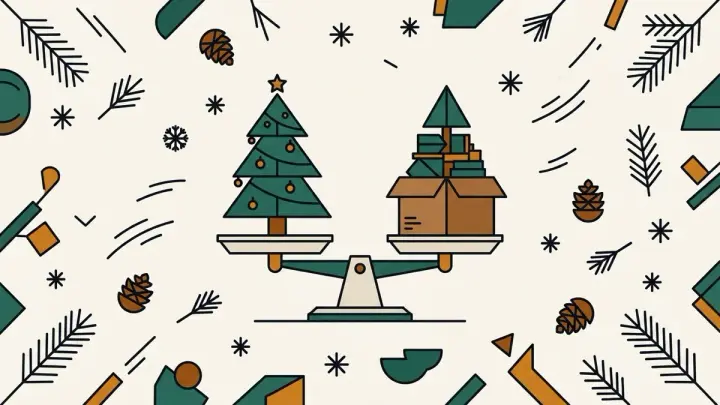
Every December, the same argument resurfaces: is it actually cheaper to keep buying a real tree, or should you have just bought a fake one years ago? The honest answer depends on numbers most articles never ask you for — what you actually pay for a real tree, and how many years you'll realistically keep an artificial one.
Average christmas tree price 2026
According to the American Christmas Tree Association (ACTA), the average real tree costs $80 to $100 this year, roughly 10% higher than in 2023 due to inflation and regional drought affecting tree farms. Artificial trees span a much wider range — $85 to $1,000 or more — though ACTA's own survey found 52% of buyers paid under $200 and another 27% paid between $200 and $400.
Is a real or fake Christmas tree cheaper?
It depends entirely on how long you keep the artificial one. Buy a real tree every year at $90, and after two years you've spent $180 — more than a $150 artificial tree that you'll use for years afterward at no additional cost. But if you only keep the artificial tree for one season, the real tree wins every time. This is a break-even problem, not a fixed answer.
Artificial Christmas tree break even: how to calculate your own
The math is simple division: take the artificial tree's price and divide it by what you'd pay for a real tree each year. A $150 artificial tree against a $90/year real tree breaks even after roughly two years — by year three, the artificial tree has clearly saved you money. A pricier $400 artificial tree against the same $90/year real tree needs about 4-5 years to break even.
How many years to use artificial tree to save money — and why sources disagree
Here's where it gets murkier: studies disagree on how long people actually keep artificial trees. Some consumer surveys put the average around 6 years; a life-cycle assessment commissioned by ACTA models scenarios up to 10 years; other estimates for well-maintained trees go as high as 15. Rather than pick one figure and treat it as fact, it's more useful to set your own realistic number — how many years do you actually expect to keep the tree you're considering? — and calculate your break-even from there.
Try the Christmas Tree Cost Calculator →
Sources: American Christmas Tree Association, cited via Family Handyman "How Much Are Real Christmas Trees?" and the ACTA 2018 Life Cycle Assessment; Kiplinger, "Fake vs. Real Christmas Tree: Which Will Save You More?"; RECOUP and Ecochain summaries of Christmas tree life-cycle assessment research on artificial tree lifespan estimates.