Most password advice focuses on strength -- add a symbol, make it longer, avoid dictionary words. That advice matters, but it misses the failure mode that actually does the most damage at scale: reuse. A single password, no matter how strong, protects exactly as many accounts as the number of places you haven't reused it.
Password reuse statistics 2026
A 2025 Cybernews analysis of over 19 billion passwords leaked between April 2024 and April 2025 -- drawn from hundreds of breach incidents plus legacy data going back to 2012 -- found that 94% were reused or duplicated across different accounts. Only about 6% were unique to a single account. That figure is cumulative across a huge and messy dataset, so treat it as a directional signal rather than a precise measurement of any one person's habits -- but the direction is unambiguous: reuse is the norm, not the exception.
Why is reusing passwords dangerous
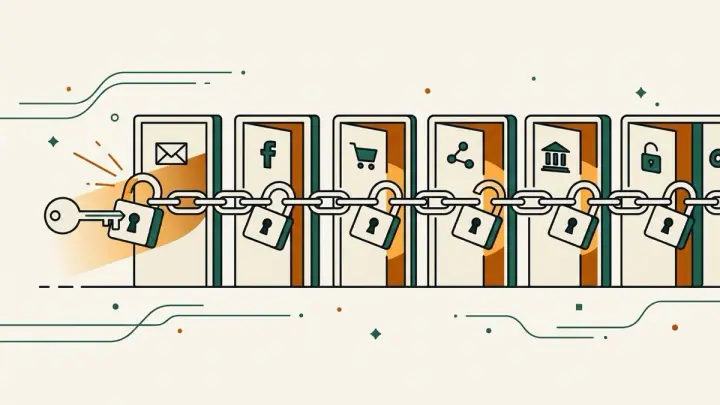
The mechanism is credential stuffing: once a password leaks from any one breached service, attackers automatically try that exact username/password pair against every other major site. If you used the same password on your email, a shopping account, and a forum, a breach at the least-secure of those three now threatens all three -- even though only one of them was ever actually compromised. The weakest link in your password hygiene sets the security ceiling for everything else that shares it.
How many accounts use the same password
This is the number most people have never actually counted. It's worth doing the exercise deliberately rather than guessing: think through your email, banking, shopping, social, and any old accounts you rarely log into, and count how many currently share one password. The number is often higher than expected, especially for older passwords created before password managers became common.
Blast radius of a leaked password
"Blast radius" is a useful way to frame it: it's not about whether any single account gets breached, it's about how far the damage spreads once one does. An email account in that mix raises the stakes further, since email is frequently the recovery mechanism for other accounts -- a compromised inbox can let an attacker reset passwords on accounts that never even shared the leaked password directly.
You don't need to check a real password against a breach database to get a useful picture of your own exposure. The Password Reuse Exposure Calculator asks only for numbers -- how many accounts share a password, and whether email, banking, or social accounts are among them -- and estimates your blast radius entirely in your browser, with no password ever typed in and no network request made.
Try the Password Reuse Exposure Calculator →
Sources: Cybernews 19-billion-password breach analysis (April 2024-April 2025), as reported by Heimdal Security, DeepStrike, and Enzoic's 2026 password statistics roundups; Have I Been Pwned FAQs on k-anonymity and breach-checking limitations.